Flat Collar for Dogs: Types Compared and How to Fit One
A flat collar holds ID tags and a leash clip for everyday wear. See how it compares with other collar types, then fit it with the two-finger check and an ID-tag checklist.
The Millbrook Team
November 25, 2026 · 6 min read
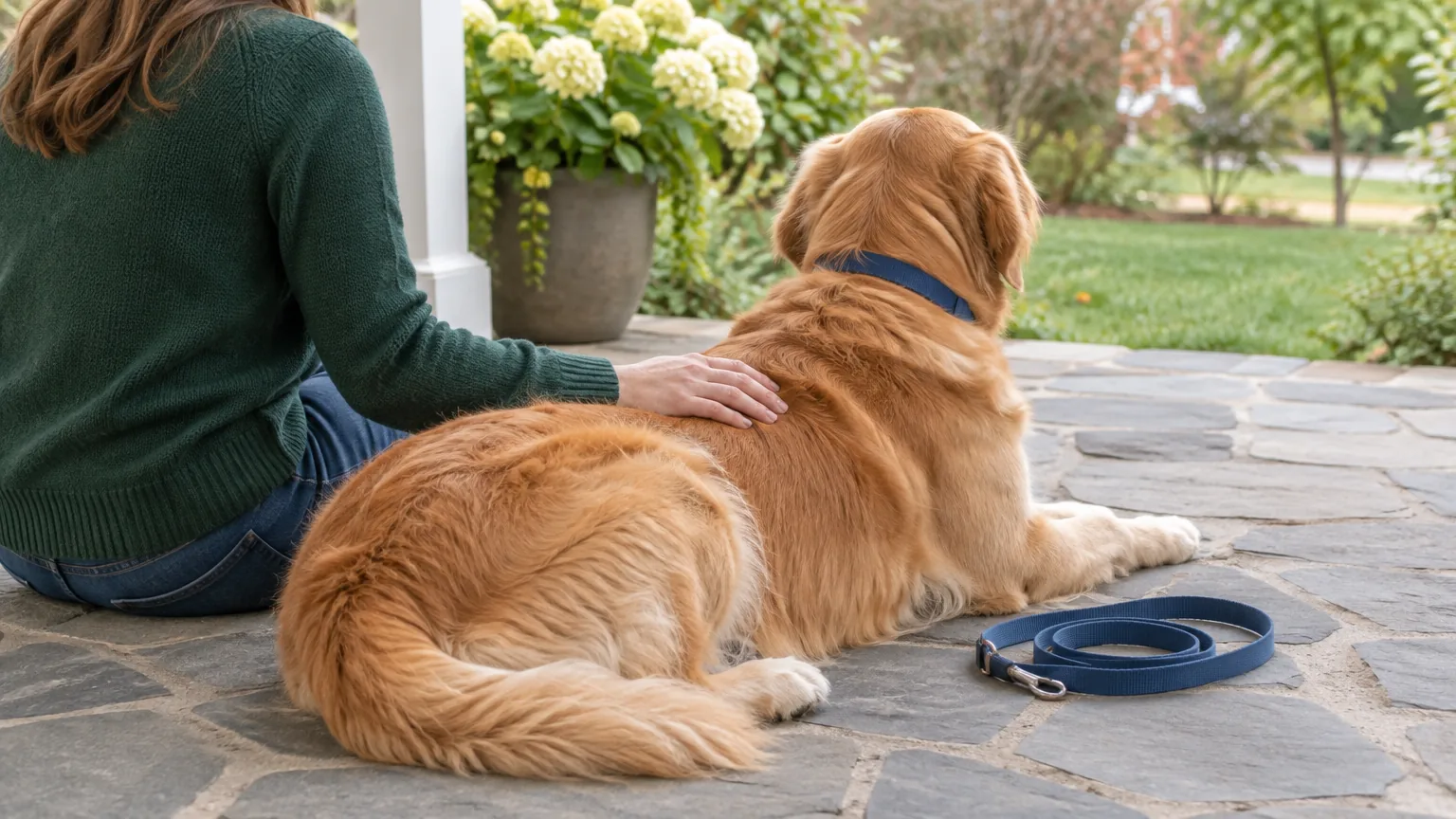
A flat collar dog owners use every day is a plain buckle band that holds ID tags and a leash clip. Fit it so two fingers slide flat between the band and your dog's neck, attach a current ID tag, and switch to a harness or another tool if your dog pulls hard. The table below sets each collar type against its use.
What a flat collar is and what it does
A flat collar is a single strip of nylon webbing, leather or similar material that closes with a buckle or a clip. It has a ring, often a metal D-ring, where you attach tags and the leash. It does not tighten when the leash goes taut, which is the main difference from slip and martingale styles.
The job of a flat collar is simple: it carries identification and gives you a leash attachment point. A dog can wear one every day, so it is the base layer of a dog's gear. Other tools are added when a dog has a specific need, such as pulling or a narrow head.
If you are browsing options, our Dog Apparel & Accessories collection lists collars alongside other wearable gear.
Dog collar types compared by use
Use this table to match a collar to the situation. Specs vary by model, so check the product page and the manual before you buy or use any of them.
| Collar type | Built for | How the leash attaches | Things to know |
|---|---|---|---|
| Flat collar | Everyday wear and ID tags | D-ring on the band | Does not tighten; fit with the two-finger check |
| Martingale collar | Dogs whose heads are narrow enough to slip a flat collar | Ring on a control loop | Has a loop that tightens to a set point; follow the manual for sizing |
| Head collar (head halter) | Dogs that pull on the leash | Ring under the chin | Needs a gradual introduction; ask a trainer for help with fit |
| Light-up collar | Early-morning and after-dark walks | D-ring on the band | Needs charging; check how tags attach |
| Cone collar | Used when a veterinarian specifies it | Not for leash use | Ask your veterinarian about wear and fit |
| Flea and tick collar | Parasite products | Not designed for leash use | Ask your veterinarian; follow the label |
| Electronic training collar (e-collar) | Remote training tools | Not a leash collar | Follow the manual; ask a qualified trainer first |
Choke chains, prong collars and shock collars are aversive collars, built around correction rather than reward. Ask a qualified trainer about other training methods before considering one.
When a flat collar is a good fit, and when it is not
Good fit
A flat collar suits a dog that walks calmly, wears tags daily and has a neck wider than the head. It is also a good base for a puppy collar, since you can adjust the strap as the neck grows. Recheck the fit often while your puppy is growing.
Consider another tool
If your dog pulls hard, a harness that clips at the chest, or a head halter, changes where the leash attaches. If your dog backs out of collars, a martingale is built for that case. Our guide on how to use a slip leash covers fit, position and handling for a related style.
Keep the flat collar on even when you use a harness, so the ID tag stays with your dog. Clip the leash to the harness and let the collar carry the tags.
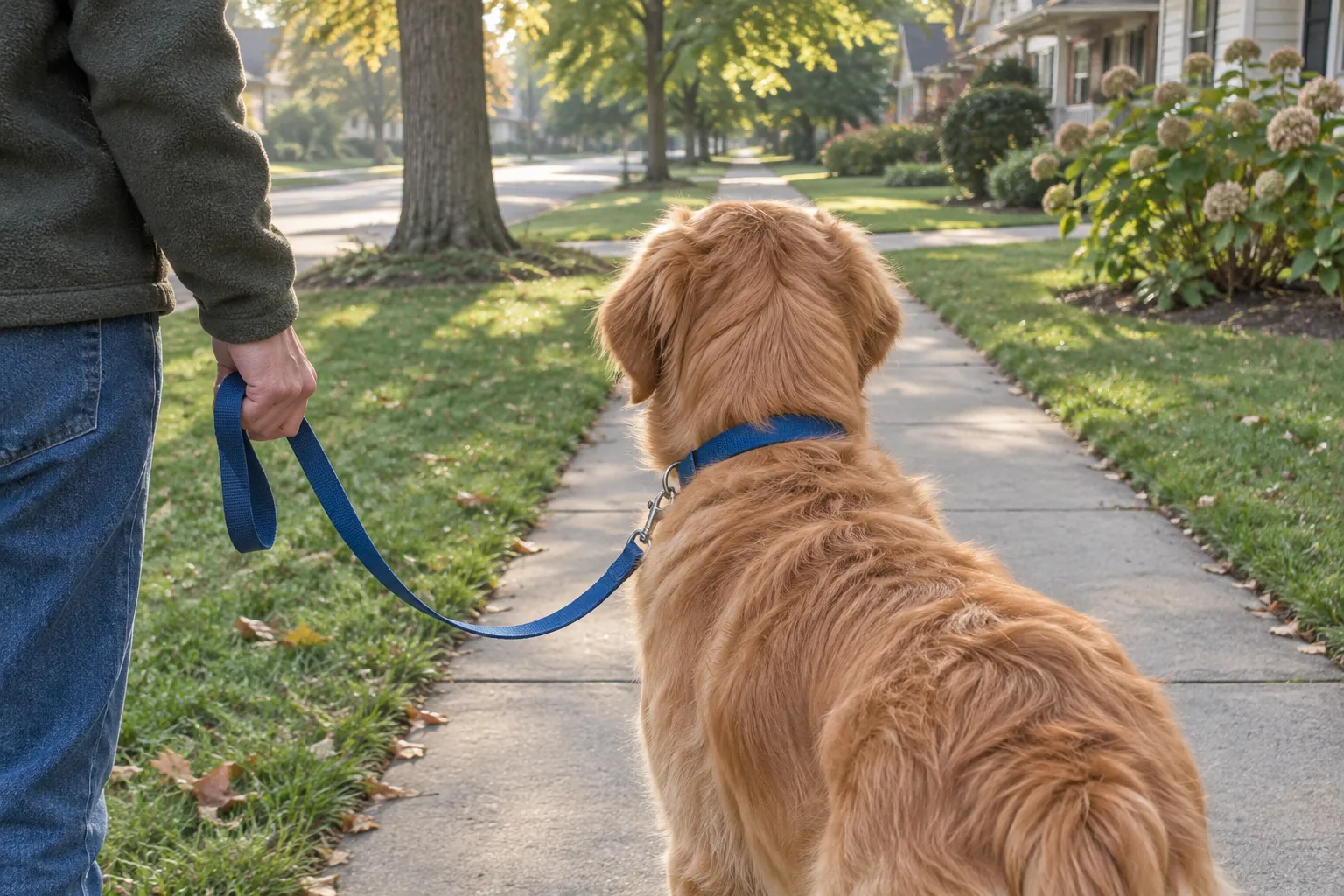
Flat collar dog fit: the two-finger check
Fit the collar while your dog stands relaxed. Have a few small food rewards ready so the process stays calm.
- Measure the neck with a soft tape where the collar will sit, and compare the number with the size range on the product page.
- Buckle the collar on a middle hole or strap position, so you have room to adjust in both directions.
- Slide two fingers flat between the band and the neck. They should fit without force.
- Gently pull the collar up toward the ears. It should not slide over the head.
- Look for gaps or twisting, and make sure the buckle is fully closed.
- Recheck the fit whenever your dog's coat or size changes.
If two fingers do not fit, or the collar slips over the head, adjust the strap again. If you cannot get a fit, ask a groomer, trainer or veterinarian to check it with you.
For the first days, let your dog sniff the collar, buckle it on for short periods and give a snack. If your dog keeps pawing at it, ask your veterinarian or a trainer for advice.
Field note
Check the two-finger fit on a flat collar after a bath or a coat change, and any time you swap collars. Keep the tag ring closed and the buckle fully clicked.
ID tag checklist
The tag is the main reason a flat collar earns its place. Run through this list when you set up a new collar or tag.
- Phone number you answer, engraved or printed clearly.
- Dog's name, if you want it on the tag.
- A split ring that is fully closed and not bent open.
- Tag size that does not drag on the floor or crowd the buckle.
- Letters that are still readable; replace worn tags.
- Updated details after a move or new phone number.
A personalized collar with embroidered or printed contact details can add a second layer of identification. Microchip registration is a separate step, so ask your veterinarian about it.
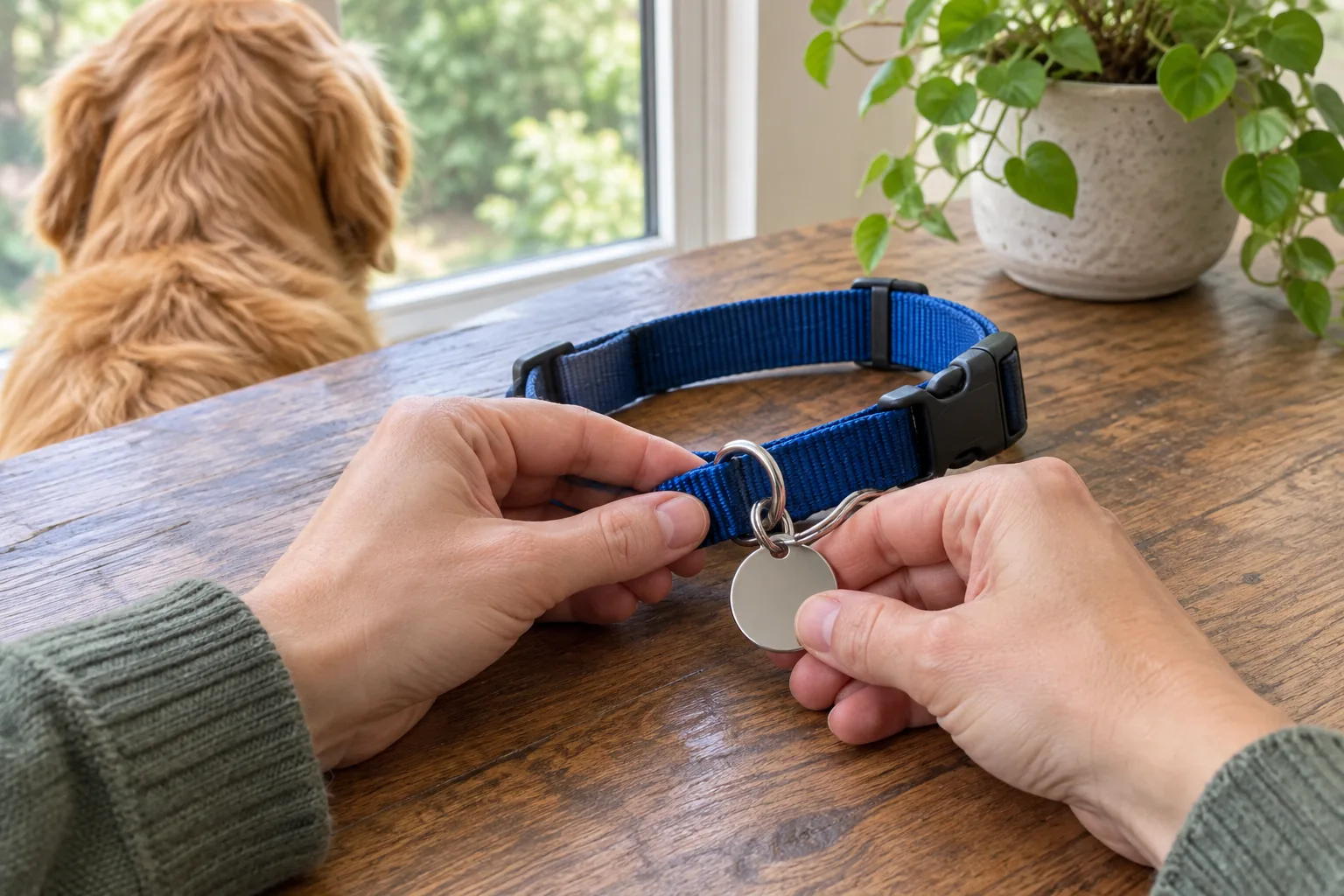
A flat collar with lights for dark walks
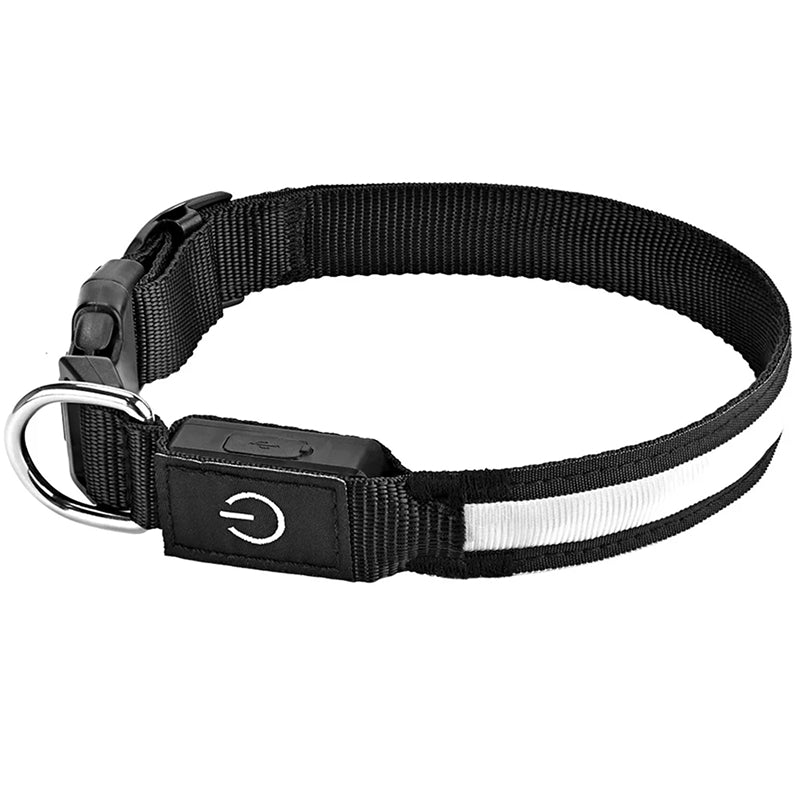
If you walk before sunrise or after sunset, a light-up collar adds a visual marker around the neck. The Twilara is a light-up dog collar with built-in LEDs, soft nylon webbing about 1 in (2.5 cm) wide and an adjustable strap. It has a metal D-ring for the leash and several color-changing light modes.
The strap adjusts to set the fit, and the product page lists the neck range, roughly 13.0 to 22.8 in (33 to 58 cm) across its sizes. It charges over USB-C. Set the fit with the same two-finger check, and check the product page for where to attach an ID tag.
 In this guideTwilara$59.99View
Cone, flea and e-collar types
Several items called collars are not everyday collars at all. A cone collar is used when a veterinarian specifies it, and fit and wear time come from that veterinarian, not from a general rule. A flea and tick collar is a parasite product, so read the label and ask your veterinarian which products suit your dog.
An e-collar is a remote training device. Follow the manual, and ask a qualified trainer before use. Ask your veterinarian whether your dog can wear a regular flat collar with tags alongside these items.
Materials, closures, care and mistakes to avoid
Nylon webbing and leather are both used for collars. Wipe webbing with a damp cloth when it gets dirty, then let it dry fully. Check the care label on leather collars, which may differ from nylon.
Band width should suit the dog's size: a narrow band looks in proportion on a small dog, while a larger dog usually wears a wider one. Closures vary too. A standard buckle holds the strap at the hole you choose, while a snap-release clip opens with a press. Check the product page for which closure a collar uses.
Look over the collar on a regular schedule. These are the problems to catch:
- A collar loose enough to catch on a crate, fence or another dog's jaw.
- A heavy tag charm that clinks and tugs.
- Fraying or cracks in the stitching, buckle or D-ring.
- A collar that has stretched; adjust or replace it.
- A long line clipped to a flat collar for hard pulling; use a harness instead.
A well-fitted collar, a current tag and a regular check are the whole routine for a dog on a flat collar.