Cat Grooming at Home: A Brushing, Shedding and Trim Routine
Cat grooming at home means brushing on a schedule set by coat type, checking skin as you go, and trimming only small areas. Here is the tool order and when to call a groomer.
The Millbrook Team
November 5, 2026 · 6 min read
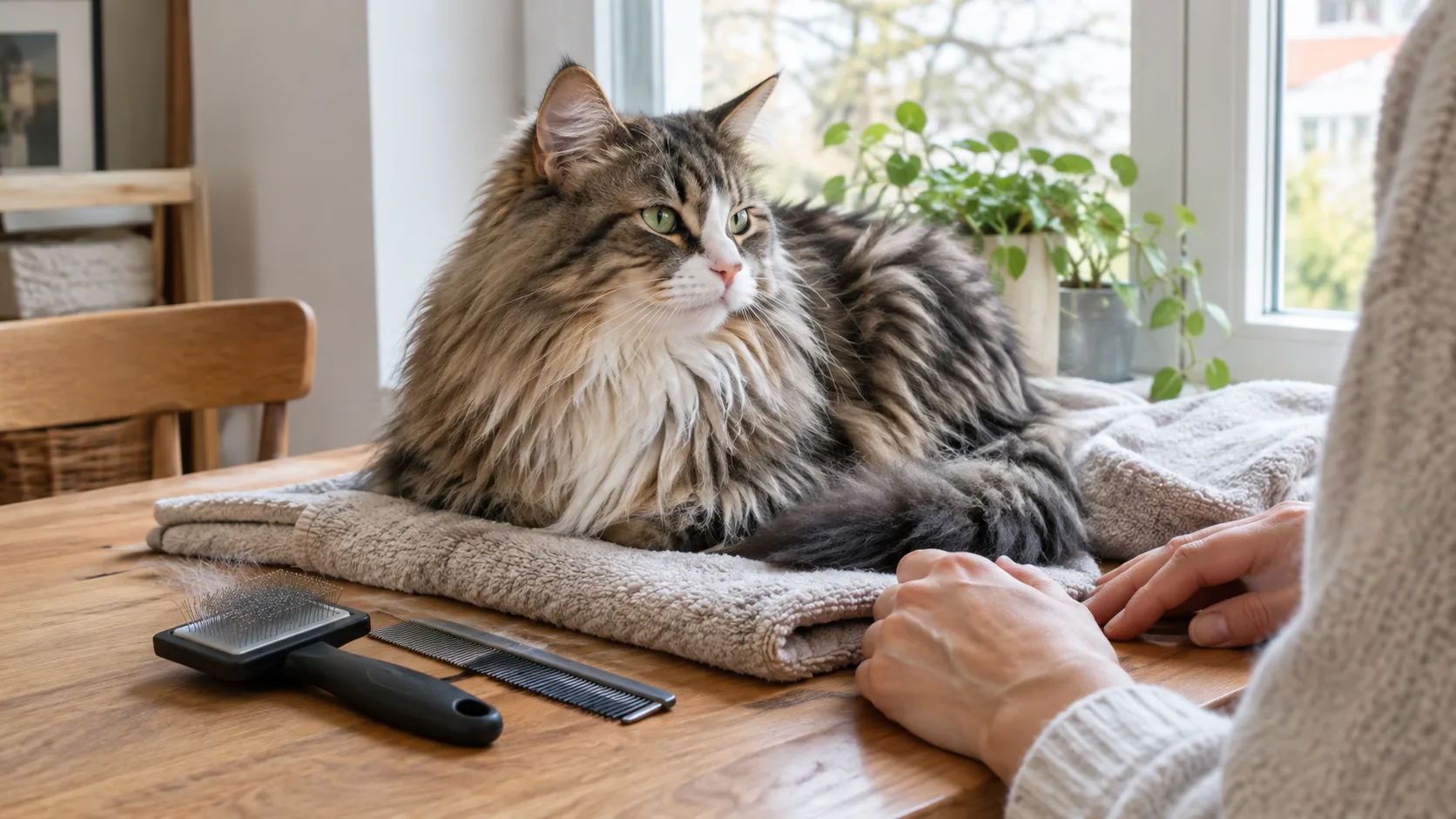
Cat grooming at home comes down to brushing on a schedule that matches the coat, checking the skin as you go, and trimming only small areas. Short coats need a weekly pass, while long coats need brushing several times a week to keep tangles from forming. Leave mats against the skin, full-body clips and anything your cat fights to a groomer or veterinarian.
Cats clean themselves, but a brush does what a tongue cannot: it lifts loose fur before it ends up swallowed or on your sofa, and it gives you a regular look at the skin and coat. This guide sorts the routine by coat type, lists tools in the order you use them, and covers what to do with a finicky cat.
Cat grooming at home by coat type
Start by identifying the coat type. It sets how often you brush and which tool comes first. These are starting points; adjust them to how much fur your cat sheds and how the coat feels under your hand.
| Coat type | Brushing | Tool order | Watch for |
|---|---|---|---|
| Short, smooth coat | Once a week | Rubber brush or soft bristle brush, then a loose-fur pass | Heavier shedding in spring and fall |
| Short, dense coat | Two or three times a week | Comb, then slicker brush, then loose-fur pass | Fur packed near the tail base |
| Medium or long coat | Every other day | Wide-tooth comb, slicker brush, fine comb | Tangles behind the ears, under the legs and on the belly |
| Fine, silky long coat | Most days | Wide-tooth comb, then fine comb | Small knots that form close to the skin |
Senior cats and heavier cats often reach fewer spots on their own, so check the back, hips and belly for tangles even if the coat is short.
Tools in the order you use them
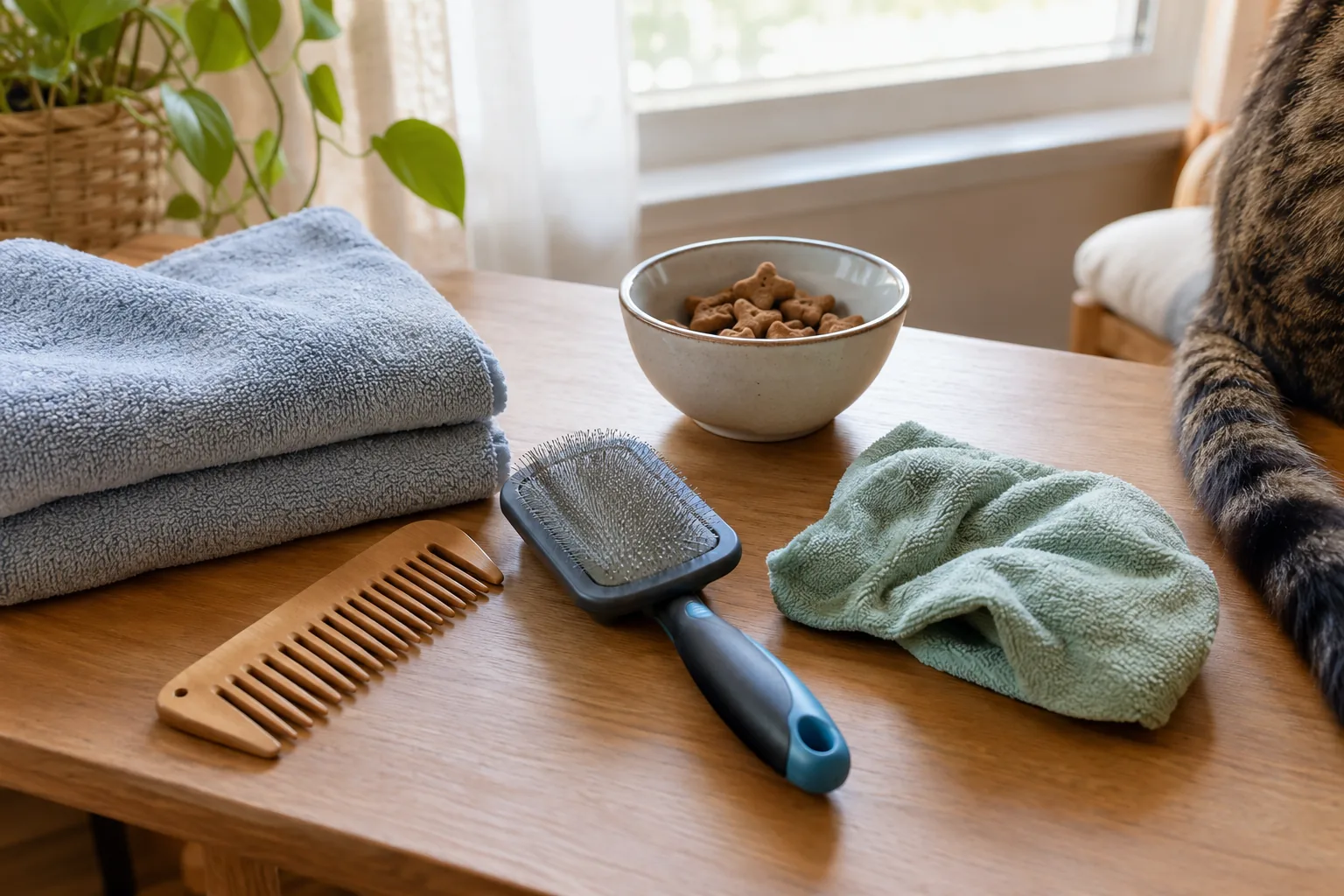
- Wide-tooth comb: opens the coat and shows you any tangles before a brush drags through them.
- Slicker or bristle brush: lifts loose fur and smooths the coat after combing.
- Fine-tooth comb: for flea checks and for the fur behind the ears and around the tail base.
- Loose-fur pass: a grooming vacuum or a damp hand run along the coat picks up what the brush loosened.
- Small clippers or blunt-tipped scissors: for trimming a small area only, covered below.
- Soft cloth: wipe the corners of the eyes and the outer ear gently.
Keep treats within reach and set everything out before you pick up the cat. Fumbling for a comb mid-session is when a cat decides it is finished.
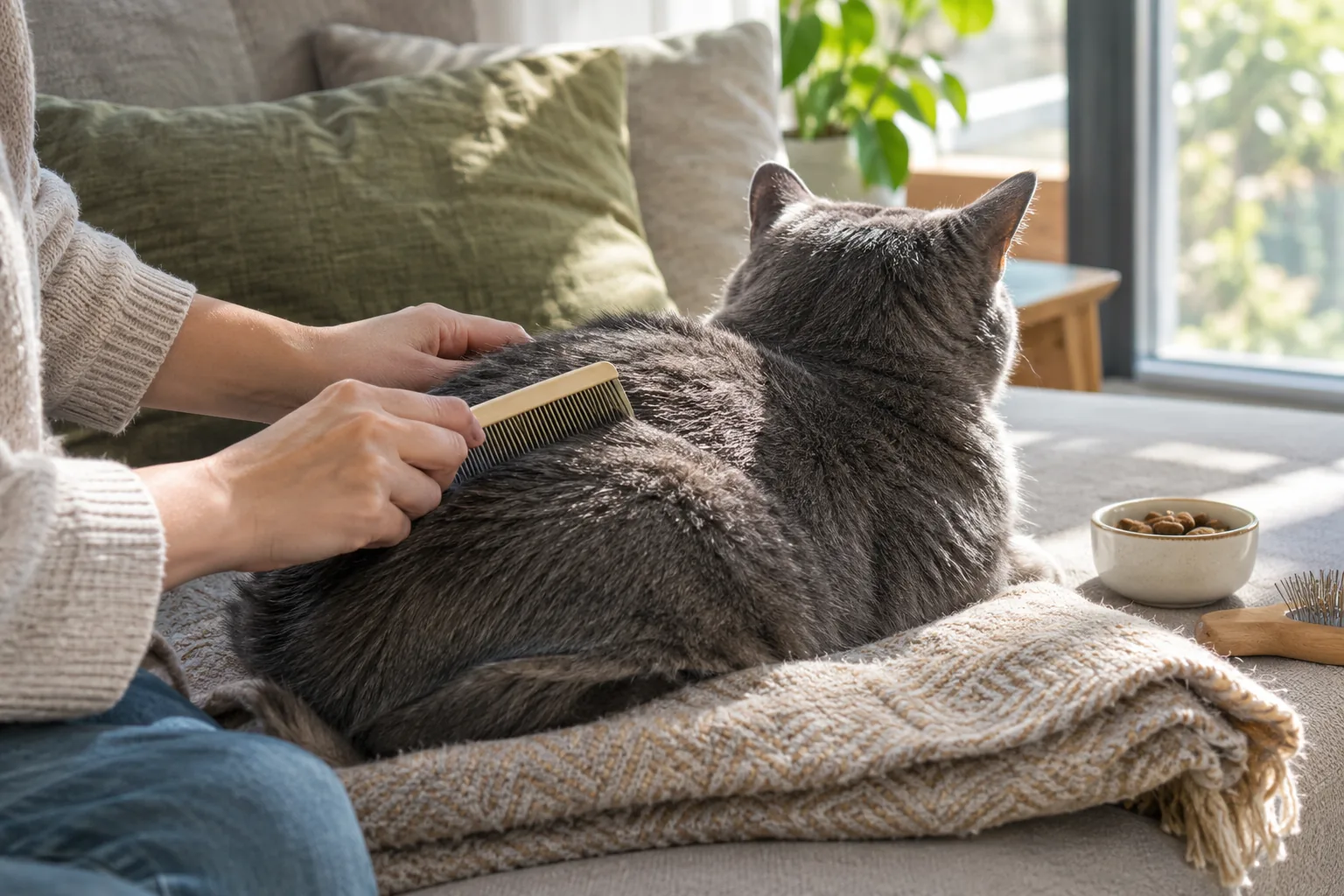
How to brush a cat, step by step
- Pick a time when your cat is relaxed, often after a meal or a nap.
- Let the cat sniff each tool, then stroke with your hand along the back for a few seconds.
- Comb or brush in the direction the hair grows, starting on the back and shoulders, where cats often accept touch first.
- Move to the sides, chest and legs. Use short strokes and hold the skin flat near tangles so it does not pull.
- Work through a small tangle by teasing it apart with the comb tip, starting at the end of the hair.
- Finish with the belly, tail and hind legs only if your cat allows it. End on a treat, even when you skipped a spot.
While you brush, part the fur and look at the skin. Redness, scabs, bald patches or small black specks that turn reddish when wet (flea dirt) are worth showing a veterinarian.
Handling shedding
Shedding is heaviest when the seasons change, and indoor cats can shed all year. During those weeks, brush more often in shorter sessions rather than one long one. A loose-fur pass after brushing collects what is still sitting on the coat.
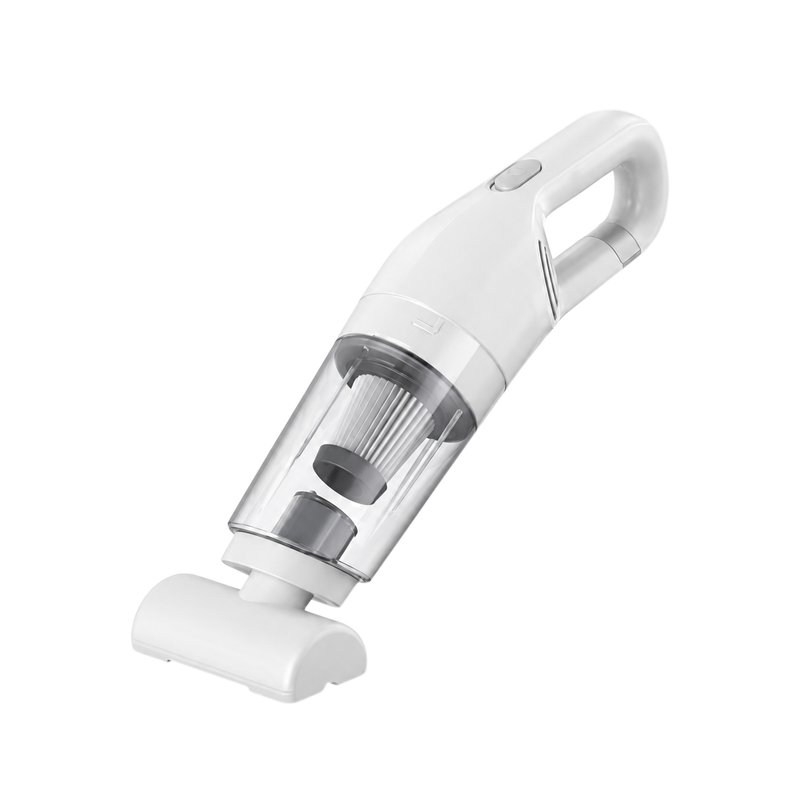
If your cat tolerates a grooming appliance, ZephyrGroom is a cordless pet grooming vacuum with a sealed dust cup. You glide the nozzle along the coat, then twist off the cup to empty it and rinse the washable filter. It runs at one steady pitch, so let your cat sniff it while it is off before a short first session. Our guide to pet vacuum grooming walks through getting a dog or cat used to it.
 In this guideZephyrGroom$89.99View
Trimming at home: what is reasonable
A cat with a healthy coat rarely needs a haircut. A trim at home makes sense for a sanitary area or the fur between the paw pads, once a comb has separated any loose surface tangles. Full shaves, often called lion cuts, are a job for a groomer who works with cats.
Do not use scissors on a mat. Cat skin is thin and loose, and it can pull up into the mat without you seeing it. Send every mat, especially one lying flat against the skin, to a groomer or veterinarian.
For small areas, look for a clipper built for turning around paws and other tight spots. TrimVelvet is a cordless pet hair clipper with steel blades that have a curved R-shaped edge and a slim contoured body that fits in one hand. It comes with four guide combs (3mm, 6mm, 10mm and 12mm; roughly 1/8, 1/4, 3/8 and 1/2 inch). An LED display shows battery level and a reminder when the blade needs oil.
 In this guideTrimVelvet$99.99View
Clipping a small area
- Brush the coat first so the clipper meets no tangles.
- Choose a guide comb or blade position and start with the longest length.
- Let the cat hear and see the clipper while it is off, then run it for a few seconds away from the body.
- Move the clipper in the direction the hair lies, with your free hand holding the skin flat.
- Stop at the first sign of struggling. Brush hair off the blade with the cleaning brush afterward.
Follow the manual for charging, oiling and use, and ask a veterinarian or groomer before clipping near the eyes, ears or any irritated skin. For longer coats on dogs, see how to cut dog hair at home for blade and guard logic that carries over to small cat areas.
Field note
Keep early sessions short. Stop while your cat is still calm, give a treat, and pick up the next day where you left off.
Handling a finicky cat
A cat that squirms or swats is telling you the session is too long or the touch is too firm. Slow down instead of holding on tighter.
- Start with the areas your cat already likes, such as cheeks and the base of the ears.
- Use a towel on a low table or your lap so the cat has stable footing.
- Brush a small section, give a treat, then stop.
- Do not grab the scruff or restrain a cat that is panting, growling or flattening its ears.
- Add one new tool at a time rather than three in a row.
- If your cat still resists after several weeks, a groomer who works with cats or your veterinarian can help.
Home or groomer: how to decide
| Situation | Home | Groomer or veterinarian |
|---|---|---|
| Weekly brushing, loose-fur pass | Yes | Not needed |
| Wiping eye corners, checking ears | Yes, gently | If there is discharge, odor or redness |
| Small trim around paw pads | Yes, if the cat allows it | If the cat resists |
| Mats against the skin | No | Yes |
| Full-body clip or lion cut | No | Yes |
| Skin changes, bald patches, fleas | No | Veterinarian |
Whether cats should see a groomer, what a visit costs and what cobbing means are answered in the FAQ below.
Common mistakes and a simple schedule
- Brushing against the lay of the coat, which pulls on the skin.
- Cutting a mat with scissors.
- Bathing a cat that does not need it. Ask a veterinarian before using any shampoo.
- Skipping the comb on long coats and using only a brush, which glides over knots underneath.
- Starting with the belly and tail, spots that cats often guard.
For a weekly rhythm, brush on the same day and time, check the eyes and ears while you do, and trim small areas only as needed. Follow your clipper's manual for charging and oiling. Browse the Grooming & Paw Care collection for more tools.